The Rise of AI Development Companies in 2026
Artificial Intelligence is no longer an emerging technology—it has become the foundation of modern business innovation. Organizations across healthcare, finance, retail, manufacturing, education, logistics, and SaaS are integrating AI into their operations to improve productivity, automate repetitive work, enhance customer experiences, and make faster, data-driven decisions.
According to industry estimates, global investment in AI continues to accelerate as businesses recognize that AI is no longer just a competitive advantage—it is becoming a business necessity.
However, implementing AI successfully requires more than simply using an AI model. Companies need expertise in data engineering, cloud infrastructure, machine learning, security, user experience, and software development. This is why businesses increasingly partner with experienced AI development companies that can design, build, deploy, and maintain intelligent solutions tailored to their goals.
In this guide, we'll explore what makes a great AI development partner, the services businesses should expect, and several companies that are helping organizations accelerate their AI journey in 2026.
Why Businesses Are Investing in AI
AI is transforming nearly every business function.
Organizations are using AI to:
- Automate repetitive tasks
- Improve customer service with AI assistants
- Generate content and reports
- Analyze large datasets
- Predict customer behavior
- Detect fraud
- Personalize recommendations
- Optimize supply chains
- Improve operational efficiency
- Accelerate software development
Instead of replacing employees, AI enables teams to focus on higher-value work while intelligent systems handle repetitive processes.
Businesses adopting AI today are often achieving faster decision-making, reduced operational costs, and improved customer satisfaction.
What Makes a Great AI Development Company?
Choosing the right AI development partner is one of the most important decisions for any organization planning AI adoption.
The best AI companies typically provide expertise across multiple technologies instead of focusing on only one AI model or framework.
Important evaluation factors include:
Industry Experience
Look for companies that have successfully delivered AI projects in industries similar to yours.
Industry knowledge helps reduce development risks and improves implementation speed.
Custom AI Development
Every business has unique requirements.
Leading AI companies build solutions specifically for business workflows instead of offering generic software.
Examples include:
- AI chatbots
- AI agents
- Document intelligence
- Recommendation engines
- Predictive analytics
- Image recognition
- Voice assistants
- AI-powered search
Full Software Engineering Capability
Artificial intelligence rarely works as a standalone solution.
Successful implementations usually require:
- Backend development
- APIs
- Cloud infrastructure
- Databases
- Security
- Mobile applications
- Web platforms
Companies that combine AI expertise with software engineering often deliver better long-term results.
Cloud Expertise
Modern AI applications depend heavily on cloud infrastructure.
Leading AI partners understand how to build scalable systems using cloud-native architectures, allowing businesses to grow without major infrastructure changes.
Security and Compliance
Enterprise AI systems frequently process sensitive customer and business data.
Development partners should understand:
- Data encryption
- Identity management
- Secure APIs
- Compliance requirements
- Privacy regulations
- Model governance
Services Offered by Leading AI Development Companies
Top AI firms generally provide a complete range of services instead of isolated AI consulting.
These services commonly include:
Custom AI Software Development
Building intelligent applications designed specifically for business operations.
Examples include:
- Business automation
- Customer service platforms
- Enterprise AI portals
- Internal productivity tools
Generative AI Development
Generative AI is one of the fastest-growing technology segments.
Companies now build solutions using large language models to:
- Generate documents
- Summarize information
- Create marketing content
- Assist developers
- Improve customer support
- Automate knowledge management
AI Agent Development
AI agents go beyond traditional chatbots.
Modern AI agents can:
- Complete tasks
- Access business systems
- Execute workflows
- Schedule meetings
- Retrieve information
- Generate reports
- Perform multi-step automation
AI agents are becoming valuable digital assistants across organizations.
Machine Learning Solutions
Machine learning enables businesses to make predictions using historical data.
Common use cases include:
- Sales forecasting
- Demand prediction
- Fraud detection
- Customer churn analysis
- Predictive maintenance
- Inventory optimization
Computer Vision Development
Organizations use computer vision to analyze images and videos automatically.
Popular applications include:
- Quality inspection
- Medical imaging
- Face recognition
- Retail analytics
- Manufacturing automation
Natural Language Processing
NLP helps software understand human language.
Businesses use NLP for:
- Chatbots
- Document processing
- Sentiment analysis
- Knowledge search
- Email automation
- Translation
- Customer support
Leading AI Development Companies to Watch in 2026
Rather than focusing solely on company size, businesses should evaluate providers based on technical expertise, engineering capability, innovation, and their ability to deliver measurable business outcomes.
OpenAI
OpenAI continues to shape the AI landscape through advanced large language models that power applications for content generation, coding assistance, customer support, research, and enterprise productivity. Its ecosystem enables developers and businesses to build AI-powered products across multiple industries.
Anthropic
Anthropic focuses on developing reliable and enterprise-ready AI systems with an emphasis on safety, transparency, and responsible AI deployment. Many organizations choose Anthropic models for knowledge work, customer service, and enterprise automation.
Microsoft
Microsoft has integrated AI deeply into its cloud platform, productivity tools, developer ecosystem, and enterprise applications. Its AI capabilities support organizations building scalable solutions across Azure and Microsoft 365.
Google continues to advance AI through research, cloud services, machine learning infrastructure, and enterprise AI solutions that power search, productivity, analytics, and business intelligence.
NVIDIA
Although widely recognized for its AI hardware leadership, NVIDIA also provides a powerful ecosystem of software, frameworks, and AI infrastructure that enables organizations to train and deploy advanced AI models at scale.
011BQ
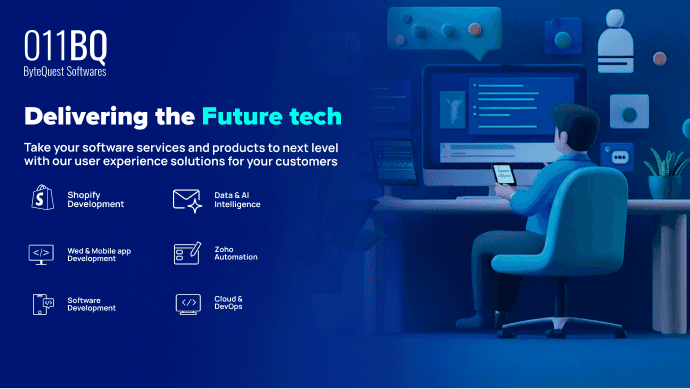
011BQ is an emerging technology company focused on helping startups and businesses adopt AI through practical, business-oriented solutions. Its services include custom AI application development, AI-powered business automation, web and mobile application development, cloud integration, SaaS solutions, and enterprise software engineering. By combining AI capabilities with software development expertise, 011BQ helps organizations build scalable digital products aligned with modern business needs.
How to Choose the Right AI Development Partner
Before selecting a technology partner, businesses should evaluate several important factors.
Technical Expertise
Review the company's experience with:
- Generative AI
- Machine Learning
- AI Agents
- Cloud Computing
- APIs
- Mobile Development
- Enterprise Software
- Data Engineering
A multidisciplinary team is often better equipped to build scalable AI solutions than a company specializing in only one area.
AI Implementation Best Practices for Businesses
Investing in artificial intelligence is only the first step. The real value comes from implementing AI strategically and aligning it with business objectives.
Successful AI adoption requires planning, collaboration, and continuous improvement.
Start with a Business Problem
Many organizations make the mistake of adopting AI because it's trending rather than identifying a genuine business need.
Start by asking questions such as:
- Which repetitive tasks consume the most employee time?
- Where are customers experiencing delays?
- What decisions rely heavily on manual analysis?
- Which processes generate the highest operational costs?
Once these challenges are identified, AI can be applied to solve specific problems and deliver measurable ROI.
Build a Scalable AI Strategy
Rather than creating isolated AI tools, businesses should build an AI roadmap that aligns with long-term digital transformation goals.
An effective roadmap should include:
- Data readiness assessment
- Infrastructure planning
- Security policies
- AI governance
- Employee training
- Performance measurement
Organizations that integrate AI into their broader software and cloud strategy often achieve greater long-term success.
Prioritize Data Quality
Artificial Intelligence is only as effective as the data it learns from.
Poor-quality data can lead to:
- Inaccurate predictions
- Biased recommendations
- Customer dissatisfaction
- Poor business decisions
Businesses should invest in data cleansing, governance, and standardized data collection before deploying advanced AI systems.
AI Use Cases Across Industries
Artificial intelligence is transforming nearly every industry by improving efficiency, reducing costs, and enhancing customer experiences.
Healthcare
Healthcare organizations use AI for:
- Medical imaging analysis
- Clinical documentation
- Patient scheduling
- Predictive diagnostics
- Drug discovery
- Virtual health assistants
Financial Services
Banks and financial institutions use AI for:
- Fraud detection
- Credit risk analysis
- Investment recommendations
- Customer support automation
- Compliance monitoring
Retail & E-commerce
Retail companies leverage AI to:
- Personalize product recommendations
- Optimize pricing
- Forecast inventory
- Improve customer engagement
- Automate customer support
Manufacturing
Manufacturers implement AI for:
- Predictive maintenance
- Quality control
- Supply chain optimization
- Production planning
- Industrial automation
Education
Educational institutions are adopting AI to provide:
- Personalized learning experiences
- Intelligent tutoring systems
- Automated assessments
- Student engagement analytics
- Administrative automation
Logistics and Transportation
AI improves logistics through:
- Route optimization
- Fleet management
- Warehouse automation
- Demand forecasting
- Delivery tracking
Emerging AI Trends in 2026
Artificial Intelligence continues to evolve rapidly.
Businesses planning long-term investments should monitor these emerging trends.
Generative AI Becomes Mainstream
Generative AI is expanding beyond content creation into software engineering, customer service, legal assistance, marketing, and business operations.
Organizations are increasingly integrating generative AI into existing enterprise systems.
AI Agents Replace Traditional Automation
AI agents are capable of completing complex, multi-step tasks independently.
Unlike basic automation tools, AI agents can:
- Understand instructions
- Make decisions
- Interact with multiple software systems
- Learn from previous interactions
This shift is expected to transform enterprise productivity.
AI + Cloud Integration
Cloud-native AI platforms enable organizations to deploy scalable solutions without investing heavily in on-premises infrastructure.
Businesses increasingly prefer cloud-based AI due to its flexibility, security, and scalability.
Responsible AI
Organizations are placing greater emphasis on:
- Ethical AI
- Explainable AI
- Bias detection
- Transparency
- Data privacy
- Regulatory compliance
Responsible AI practices are becoming essential for enterprise adoption.
Industry-Specific AI Solutions
Instead of generic AI platforms, businesses are seeking customized AI systems tailored to their industry, workflows, and compliance requirements.
This trend is driving demand for experienced AI development partners.
Why Businesses Choose 011BQ
Selecting the right AI development partner can significantly impact project success.
011BQ focuses on building practical, scalable AI solutions that solve real business challenges rather than implementing technology for its own sake.
End-to-End Development
From strategy and consulting to design, development, deployment, and ongoing support, 011BQ provides complete AI implementation services.
Also Read: 50 AI Automation Ideas Every Business Should Implement in 2026
Custom AI Solutions
Every business has unique requirements.
011BQ develops custom AI applications tailored to operational goals instead of relying solely on off-the-shelf products.
Modern Technology Stack
The company works with modern technologies including:
- Generative AI
- AI Agents
- Machine Learning
- Cloud Computing
- Mobile Applications
- SaaS Platforms
- Enterprise Software
- API Integrations
Business-Centric Approach
Technology decisions are aligned with measurable business outcomes such as increased productivity, reduced costs, improved customer satisfaction, and higher operational efficiency.
Also Read: Top 5 Marketing AI Tools Every Digital Marketer
Long-Term Partnership
Beyond initial development, ongoing maintenance, performance optimization, and feature enhancements help businesses maximize the value of their AI investments.
Final Thoughts
Artificial Intelligence has evolved from an experimental technology into a core driver of business innovation.
Organizations across industries are using AI to automate operations, improve customer experiences, make faster decisions, and create entirely new products and services.
Choosing the right AI development company is not simply about selecting the largest provider. Businesses should evaluate technical expertise, software engineering capabilities, cloud experience, security standards, and the ability to deliver customized solutions that align with strategic objectives.
Also Read: Top 5 Software Development Companies in USA
Whether you're launching an AI-powered startup, modernizing enterprise operations, or exploring generative AI, partnering with an experienced development company can significantly reduce implementation risks and accelerate business growth.
As AI continues to reshape industries in 2026 and beyond, organizations that invest strategically today will be better positioned to compete in an increasingly digital economy.
(FAQs - AI Development Company)
1. What does an AI development company do?
An AI development company designs, develops, deploys, and maintains artificial intelligence solutions such as AI applications, machine learning models, AI agents, chatbots, and automation platforms.
2. How do I choose the best AI development company?
Evaluate technical expertise, industry experience, software engineering capabilities, security practices, cloud expertise, and client success stories.
3. What industries benefit most from AI?
Healthcare, finance, retail, education, logistics, manufacturing, real estate, and customer service are among the industries seeing significant benefits.
4. How much does AI software development cost?
Costs vary based on project complexity, features, integrations, infrastructure, and customization requirements.
5. What is Generative AI?
Generative AI creates text, images, code, audio, video, and other content using advanced machine learning models.
6. What are AI agents?
AI agents are intelligent systems capable of performing tasks, making decisions, interacting with software, and automating workflows with minimal human intervention.
7. Can startups benefit from AI?
Yes. AI helps startups automate operations, improve customer support, accelerate product development, and compete more effectively.
8. Is AI suitable for small businesses?
Absolutely. Many AI solutions are scalable and can improve efficiency even for small and medium-sized businesses.
9. How long does AI development take?
Simple AI projects may take a few weeks, while enterprise-grade solutions can require several months depending on complexity.
10. Why is cloud infrastructure important for AI?
Cloud platforms provide scalable computing resources, storage, security, and flexibility required for AI applications.
11. What programming languages are commonly used for AI development?
Python is the most widely used language, along with JavaScript, Java, C++, and frameworks such as TensorFlow and PyTorch.
12. What is the difference between machine learning and AI?
Machine learning is a subset of AI that enables systems to learn from data and improve performance over time without explicit programming.
13. Can AI integrate with existing business software?
Yes. Modern AI solutions can integrate with CRMs, ERPs, SaaS platforms, mobile applications, and enterprise software using APIs.
14. Why are custom AI solutions better than generic software?
Custom AI solutions are designed around specific business processes, resulting in greater efficiency, better scalability, and improved ROI.
15. Why should businesses consider working with 011BQ?
011BQ combines AI expertise with software engineering, cloud technologies, mobile development, SaaS platforms, and enterprise application development to deliver scalable, business-focused AI solutions tailored to organizational goals.
Work with 011BQ
Building something similar?
350+ engineers. ISO-certified. Projects start in 1–2 weeks. Free consultation.
Get a Free Quote →